Pre-vacation reading, Hawaii edition

I’m in the habit of getting to know about a place before I venture there. What’s the purpose of travel, if not to learn?

In celebration of my in-laws’ 50th wedding anniversary, Bugman and I accompanied them on a trip to Hawaii last month.

I perused recommended reading lists and used bookstore catalogs, and managed to read (or mostly read) the following books before arriving on the islands.

Shark Dialogues by Kiana Davenport

I greatly appreciated the broad backdrop of Hawaiian history in this book, as well as the nuances of race and identity it presented. I have thought about Shark Dialogues several times in the context of discussions on race relations in the United States.

I found the construction of the book and some of the language awkward, however, so I can’t recommend it without hesitation.

The book begins with an introduction of one chapter for each of its main characters – matriarch Pono and four of her granddaughters. Then it veers into several chapters of ancestral backstory before settling into what I think was the strongest part of the book – telling Pono’s story. Then, abruptly, Pono becomes a secondary character, and the book shifts focus to the granddaughters. I wound up skimming through some of the later chapters as I found myself losing interest.

There are a few distracting flow-of-consciousness episodes in the book that could have been left aside. I rather wish several graphic sex scenes could have been cut from those later chapters as well, as they prevented me from recommending the book to my mother-in-law.

Overall, I’m glad to have read this book before traveling to Hawaii.

Hawaii’s Story by Hawaii’s Queen by Liliuokalani

This book, or a summary of this book, should be required reading for anyone who visits Hawaii, as well as for American History students. Hawaii is not just any old state. As numerous histories point out, Hawaii is the only state to encompass a royal palace – Ioloni Palace.

Written in the language of the turn of the 20th century, this book can be trying to read at times, particularly through the many descriptions of social engagements and royal receptions (which I believe Liliuokalani included in the book to contrast against her later treatment). However, her writings clearly illuminate an injustice perpetuated against the Hawaiian people by American citizens and, ultimately, by the United States government.

Want the Cliffs Notes version? Try reading Public Law 103-150, an apology to Native Hawaiians passed 100 years after the overthrow of Liliuokalani’s government in 1893.

A passage that struck me in particular was the following, describing Liliuokalani’s thoughts as she travels through the United States in 1896:

Miles after miles of rich country went by as we gazed from the windows of the moving train, and all this vast extent of territory which we traversed belonged to the United States; and there were many other routes from the Pacific to the Atlantic with an equally boundless panorama. Here were thousands of acres of uncultivated, uninhabited, but rich and fertile lands, soil capable of producing anything which grows, plenty of water, floods of it running to waste, everything needed for pleasant towns and quiet homesteads, except population. . . And yet this great and powerful nation must go across two thousand miles of sea, and take from the poor Hawaiians their little spots in the broad Pacific, must covet our islands of Hawaii Nei, and extinguish the nationality of my poor people, many of whom have now not a foot of land which can be called their own. And for what? In order that another race-problem shall be injected into the social and political perplexities with which the United States in the great experiment of popular government is already struggling? …

Kauai: The Separate Kingdom by Edward Joesting

I managed to get about 3/4 of the way through this book before I ran out of steam. I definitely learned some things, but I found it hard to stay interested in the litany of dates, places, and names, and wound up reading many pages over and over again without absorbing the info.

The first two chapters, before Captain Cook and the whalers showed up, were most interesting to me.

(Wouldn’t “Captain Cook and the Whalers” make a good band name?)
Where do you read?

I was prompted to think about this question by a story on NPR by Juan Vidal, “Reading On The Roof? Now That’s Punk Rock.”

Fascinated as I am by the different ways that people choose to consume literature, I figure why not experiment with some I’ve never tried. A quick search on Goodreads leads me to a fascinating poll where readers share the many places they’ve brought books. There’s “Reading while riding a bike,” “Reading during bad metal bands,” and “Reading while hanging upside down from a tree limb.” You name it, it’s probably there.

I’ve tried reading while exercising, such as on a recumbent stationary bike. This does not work if the exercise is in any way intense. I can do one or the other – focus on what I’m reading or focus on putting forth a physical effort – but I can’t do both.

I can’t say that I’ve read in any particularly memorable places, in part because I tend to be highly distractable. Set me with a book in my hand in the midst of crowds of people (coffee shop, airport), and my attention tends to drift towards the people. (Having your nose in a book is great cover for eavesdropping.) I wind up reading the same page over and over again without absorbing it. If I do manage to get into the book, I’m fully in the book and block out my surroundings entirely, so I’d not be likely to remember locations anyway. So, my recalled reading locales tend toward the pedestrian.

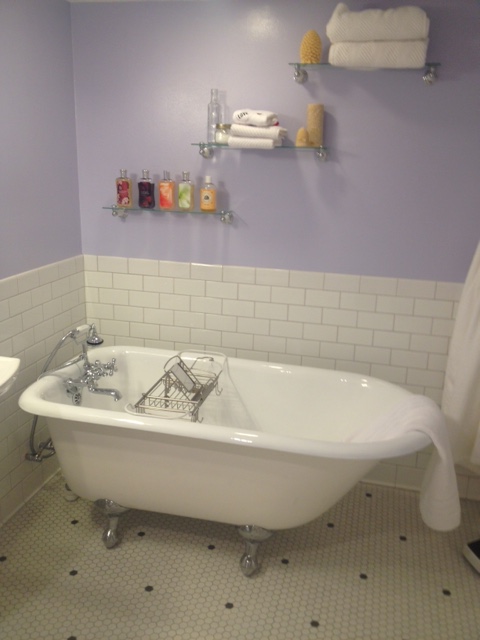
Other than the various couches and chairs in my or family members’ homes (including a favorite hand-me-down chair I acquired during college, which desperately needs reupholstering but has perfectly sloped wooden arms to enable me to drape myself sideways over the chair), the only “unusual” place I can recall reading is in the clawfoot bathtub we installed in our house shortly after moving into it. (See here for a story about that, and how I learned to use Bondo.)

IMG_5310

A clawfoot tub – the most “unusual” place I can recall reading.

I bought a “book rack” for the tub, on which I can prop my literary pick. This rack also has an arm designed to hold a stemmed wine glass, which Bugman has, on occasion, refilled for me while I soaked – the dear!

The toughest part of reading in the tub is keeping the pages dry.

House rule: don’t put the book on the rack while the tub is filling. It will get wet from the spatter of the tap.

Developed technique: reach back and dry fingers on the bathrobe hanging from the wall hook before picking up the book.

As a commenter on that NPR story noted, a place can sometimes trigger memories of a book read there.

I distinctly recall the first book I read in that tub, a book picked up on a whim at a used bookstore – Two Old Women. Remaining in the tub long after the bathwater had grown cold added a kindred physical element to the experience of reading a tale of abandonment in the Alaska wilderness.

Two other books I can recall reading in that tub – Karenna Gore Schiff’s “Lighting the Way – Nine Women Who Changed Modern America” and “Shark Dialogues” by Kiana Davenport.

Interesting that all three of my recalled tub-readers were books centered on women. I wonder if that was an unconscious choice, influenced by decades of exposure to newspaper cartoons and consumer culture (Calgon, take me away!) depicting women escaping to the tub.

The bathtub is exactly the type of paradisal refuge I seek for my focused reading – no phone, no Internet, no distracting conversation, no temptation to get up and go accomplish that one little thing that popped into my head, leading to a chain of minor chores and an abandonment of my reading.

In thinking about ideal places to read, I find myself wishing I had a treehouse. Climbing up into a treehouse would provide a similar refuge from distractions. I can picture myself up there, mind becalmed by the gentle rush and dappled shade of breeze-ruffled leaves. Ahhhh . . .

So, what is your ideal reading place?

Reading the classics

Once upon a time, I stopped reading fiction.

“I have limited time,” I said. “Why would I spend that time reading made-up stuff when there is so much REAL stuff out there I could be reading and learning about.”

I did learn a lot – about diseases, storms, human inventions, the practice of medicine, ethical dilemmas in science, etc.

I was becoming a more informed citizen of the world.

But I was missing something, too.

Stories.

Our human brains crave stories. We read them. We make them up. We weave them around our realities to make sense of our lives.

I was ignoring the context of the human truths fiction can unearth.

I started reading fiction again. I found bits of the stories floating to my mind as I was going about my day. Those books – the good ones, anyway – really do help me to process the world around me.

Some articles that have recently appeared in my social media feeds inspired me to think about this topic again, and to write this post.

First, an opinion piece by Dr. Loretta Jackson-Hayes in The Washington Post: “We don’t need more STEM majors. We need more STEM majors with liberal arts training.”

Then, Punchnel’s blog post by Jamie Leigh “10 Reasons You Should be Reading the Classics.”

I’m taking the challenge to heart. On my to-read list, Gabriel Garcia Marquez’s “Love in the Time of Cholera” is up next.

I’d like to revisit some Russian writers, too. I read Tolstoy and Dostoyevsky in college, and I’m inspired to return to them after reading in Atul Gawande’s “Being Mortal” that his medical schooling included a seminar in which the students read and discussed Tolstoy as a jumping-off point to examine the emotions and social structures around the process of dying.

What classics have you found relevant to your life recently?

Undervaluing writing

A friend posted an article and the following comment on social media this morning:

Ten Things You Shouldn’t Say When Pricing Handmade Items

I have had this discussion often with people selling at the farmer’s market or in our shop.

I commented:

#7. I just enjoy making it, I don’t care how much I get for it
*sigh*
Kind of applies to my blogging. Since I’ve started posting [on SCB Citizen] again, I’ve gotten a lot of positive comments from people about how much they missed my writing. And then there was the comment from a friend last week who said “I don’t pay for news. I can get it online for free.” Writing is seriously devalued these days. A lot of people will write articles for magazines for free, just to get their name in print or to promote their agenda. A lot of content online gets “stolen” by copy-pasters. I’m doubting my sanity for having taken a leap into it as a career on spec. How much of it do I need to do to “advertise” myself and build up my reputation, and when can I start charging for the work I do? Or will it forever be relegated to a hobby?
*sigh*

The discussion reminded me of the uber-valuable website “Who Pays Writers?

I love this website, because it helps writers overcome asymmetric information, which can lead to failure in the market for writing services. (Yeah, I took some microeconomics classes in grad school.)

The social media conversation continued.

Do you think women are more inclined to undervalue their work or is it a non-gender artisan thing?

Good question! If data on salary negotiations are any indication, I’d say the former.

For info on the above assertion about salary negotiations, see this Forbes article.

Discussion, anyone? Comment section is open!

How’s your book coming?

I got a text message this week from my mom, who’d met someone for lunch who asked about me:

She wants to know how your book is coming.

A perfectly innocent question, but it irritated me.

Googling “things not to ask a writer” turned up no links that could succinctly explain my annoyance.

I replied:

I can’t answer her question. There is no book and there may never be one. All I can do is write. Maybe it will happen. Maybe this will all just be a futile exercise in self-indulgence.

*cringe*

That came off pretty harshly.

There was no offense meant by the question. Since I’ve started revealing to people that part of my reason for leaving my last job was to enable me to take the time to work on a writing project and perhaps get a book published, lots of people have been asking me that same question.

It’s really hard for me to respond, for a number of reasons.

Looming large among them is my self-image.

I can’t escape this feeling of being branded as feckless. I get the sense that some of the people who knew me as “Katie Bradshaw, museum director” are at a loss as to why I would leave a position of leadership in the community without another solid job to move on to. Some have taken to referring to me as “retired.”

That classification is hard for me, as I have this need to feel “legitimate.” In a culture that values hard work, in a society in which people are defined by their occupations, being perceived to be “dropping out” of the workforce makes me feel persona non grata.

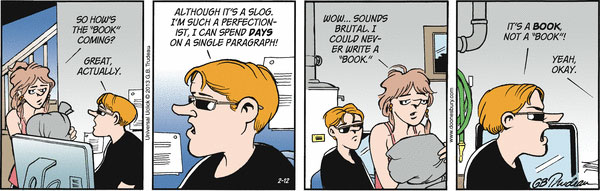
Also, there’s that whiff of ignobility that has tended to haunt writers. (And cartoonists.)

Chalk one up for Doonesbury.

Chalk one up for Gary Trudeau & Doonesbury.


Because of this chip on my shoulder, the innocent question “how’s the book going?” transmutates in my brain into “when are you going to do something productive?”


In a previous conversation, in response to a previous “how’s the writing going” question, Bugman helped me come up with another, less fraught, response.

It’s a process.

Indeed, it is.

When I was looking for “things not to ask a writer,” I’d also Googled “how’s the book going,” which led me to an article in The Globe and Mail by travel writer Will Ferguson. To quote:

With writers, the correct question is never “How’s the writing going?” but rather “How is the not writing going?”

Not writing is the easiest thing in the world to do. And that’s what an author means when she says she is “working” on a book. Working means “not writing.” Working means reading, working means “research.” Working means watching TV. Working means taking long diversionary walks. Working means perusing newspapers with an unnaturally intense interest. It means everything and anything except the actual act of writing.

While the above statement is a bit tongue-in-cheek, it really gets at the heart of what a lot of writing is all about.

I generally don’t just sit down and pound out a chunk of writing.

I think. I do research. I get distracted. I get stuck. I write and rewrite and delete and tweak and cull. I read something on an unrelated topic, and a fortuitous cross-fertilization of ideas happens. I go for a bike ride and suddenly hit upon a solution to a problem.

Writing is a process.

Becoming a better writer is a process.

It’s the journey, not the destination.


Today, while taking a walk, I suddenly came to a realization. If I’d told people I was leaving my last job to go back to school, there would not be the same questions hanging in the air about my identity. I wouldn’t be “retired.” I’d be a “student.”

So, I will just think of myself as a student.

Rather than paying money for tuition in a formal program, I am paying time-away-from-wage-earning for a period of independent study.

I’m learning how to use Twitter. I started two new blogs and am trying to keep up with two existing ones. I’m keeping two journals. I’m corresponding. I’m reading more than I have in years.

Reading classic literature. Reading magazines. Reading blogs. Reading book reviews. Reading “the competition.” Reading about writing.


I’m grateful to my family and friends who are encouraging me, who care enough to ask “how’s the book coming?”

I’m grateful when people understand how scary it is for me to step away from stability and fling myself onto a path that may or may not yield any tangible benefit.

And I’m grateful for my mom’s response to my text-message outburst:

At least you are giving it a shot.

Weekly planning for my writing life

I’m a list-maker.

It’s not just the thrill of crossing something off the list that drives me to this method of organizing my days.

It’s the fact that I will forget about things if they are not there in front of me, on paper. (Digital lists don’t work for me. I’m a paper gal.)

When I’ve burned out on one task, or when I have a few minutes before an appointment, I’ll check my to-do list to see if there isn’t something I can knock off, or at least get started on.

I still sometimes have problems getting everything done, though. I’m still trying to figure out how to structure my writer’s life to best effect.

I kind of like the idea I bumped into today, via an article in The Muse. It highlights a work habit of Jack Dorsey (of Twitter and Square fame): identify a “theme” of each work day, and keep returning to that focus, even if you get distracted by day-to-day tasks.

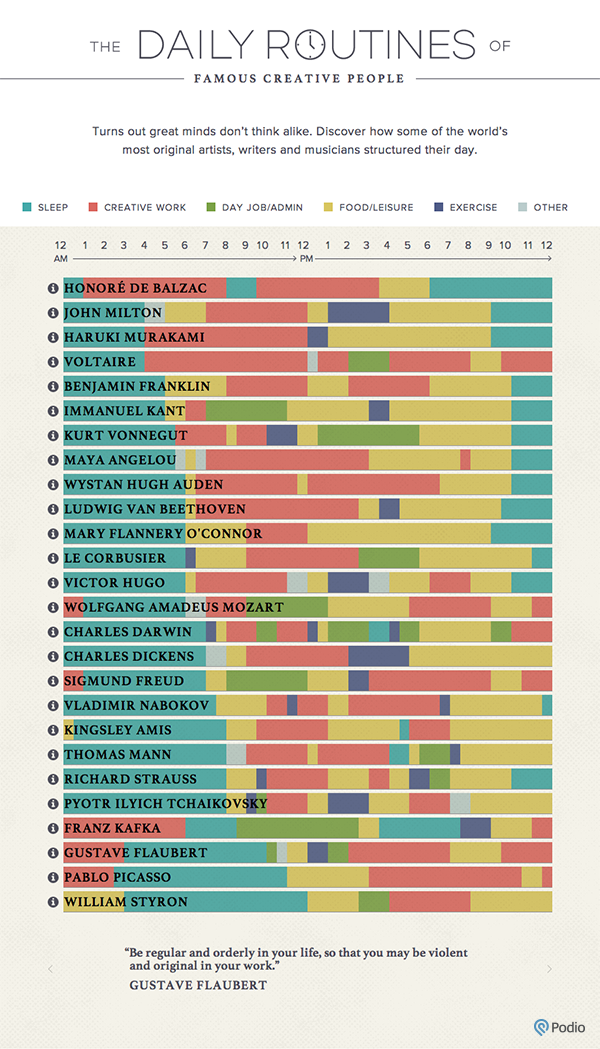
It also made me think of a Podio infographic I saw come through my social media feed recently, which invited readers to match their daily routines with those of famous creative people. (I probably most resemble Victor Hugo.)

full_embedAnd, in my search for the above infographic, the rabbit hole o’ the Interwebz led me to another book to add to my to-read pile: Daily Rituals by Mason Currey.

What does your daily routine look like when you are at your most productive? What elements are necessary for your writing life?

Aside

Poetry – an excuse for a party

Ever since I visited Scotland and was subsequently invited to a Burns Night supper in Iowa, I’ve tried to host a Burns Night celebration of my own every year.

What better excuse for a party than poetry, and Scotland’s national poet, Robert Burns?

I was first exposed to Burns’ poetry in a Romantic Literature course in college. My favorite of his poems remains “To A Mouse, On Turning Her Up In Her Nest With The Plough.”

The best-laid schemes o’ mice an ‘men
Gang aft agley,

If you’re not sure what all a Burns Night supper involves, you can download the Robert Burns app. Yup. Seriously. It was developed by the Scottish tourism bureau, to good effect, I would say.

My parties typically involve:

  • bagpipe music (recorded)
  • tartan worn in some fashion
  • scotch and/or Scotch ale
  • cock-a-leekie soup
  • neeps & tatties (mashed turnips & potatoes)
  • a vegetarian haggis

My party this year was a few days delayed past January 25 – postponed due to a nasty cold. Happily, we still were able to fill our table with guests.

Kilt-clad Bugman, setting the haggis at the table. Not quite as "warm-reekin', rich" as a traditional haggis, but more easily stomached for some.

Kilt-clad Bugman, setting the vegetarian haggis at the table. Not quite as “warm-reekin’, rich” as a traditional haggis, but more easily stomached for some.

This year, we were treated to a flamed plum pudding, which one of the guests brought.

flamed pudding

I’ve never seen a pudding flamed before. It was lovely!

Until next year, dear haggis – should auld acquaintance be forgot!

Copyright 2015 by Katie Bradshaw

Status

A Month of Letters participant

LetterMo2015square-1024x1024I plan to participate in this year’s A Month of Letters challenge, in which I will send at least one letter every day in February that the post runs.

Why?

In no particular order, I give you:

My Top Seven Reasons for Participating in A Month of Letters

1. It will help me keep resolution #6 to “nurture personal connections.”

2. Daily writing practice is daily writing practice.

3. Perhaps I will finally get those Christmas thank-you notes sent out.

4. I love to use pretty notecards and stationery and interesting stamps.

5. If you look at anthologies of writers or historical personages, what do you see? Their collected writings. Letters, often. How will future anthologies look if all anyone ever writes is social media posts? Barring me ever being famous enough for inclusion in an anthology, paper correspondence may one day be of interest to historians trying to piece together daily life from this era. As a former history museum director, I think about this. So much of the writing today is ephemeral and will be lost to history. (Speaking of which, I love Letters of Note. I found a letter in the museum archive that I have been wanting to submit.)

6. I am a paper gal. Book trumps e-reader. Letter trumps email. I like to feel the physical item in my hand. Also, old books smell better than old computers.

7. I love getting mail. I transfer my desires onto others and assume others love to get mail as well. I believe I’m creating little eddies of happiness in the universe.

I already have several people in mind to send letters to, but I’d be happy to strike up a written correspondence with a new kindred spirit. Send me an email with your mailing address to kt AT ktbradshaw DOT com.